
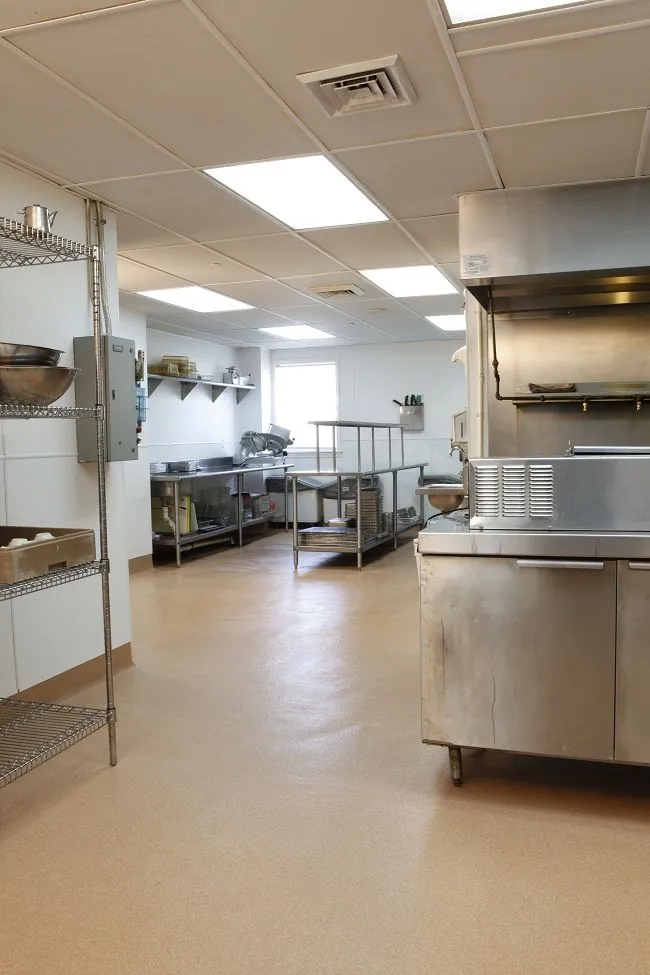
A food-service floor does not perform exactly the same way throughout its entire life. Years of carts, foot traffic, scrubbing, washdowns, grease, and cleaning chemicals can gradually change the surface. Areas that once had consistent texture may become smoother in traffic lanes while remaining rougher near walls or under equipment. This uneven wear can affect cleaning effort, drainage behavior, and traction from one zone to another. Facility managers should therefore evaluate surface texture as part of long-term maintenance rather than assuming that an intact-looking coating is still performing uniformly.
Traffic Can Polish Busy Routes
Repeated movement can gradually change the finish in the busiest parts of a kitchen or processing area. Employees, carts, racks, and cleaning equipment often follow the same routes each day.
Over time, these paths may appear smoother or more polished than surrounding sections. The change may be especially noticeable near service doors, cooking lines, dishwashing areas, and cooler entrances.
Managers should compare high-traffic routes with lightly used edges when inspecting the floor instead of judging the surface from one location.
Cleaning Can Wear Areas Differently
Scrubbing procedures do not always affect the entire floor equally. Crews may spend more time on greasy cooking zones or repeatedly use mechanical equipment along central routes.
Cleaning chemicals, brushes, pads, and repeated rinsing can all contribute to long-term changes in the finish. This does not automatically mean the floor has failed, but it can alter how different areas behave.
Facilities considering Food Services Flooring Restoration should document where the surface has become visibly worn or more difficult to maintain before deciding whether localized repair or broader resurfacing is appropriate.
Texture and Cleanability Stay Connected
Additional texture can support traction in wet or greasy environments, but a rougher surface also requires effective cleaning. As texture wears unevenly, some sections may become easier to scrub while others continue trapping residue.
The goal during restoration should not simply be to make the floor as rough as possible. Managers need a finish that suits the moisture, grease, drainage, footwear, and cleaning procedures in each zone.
A balanced surface profile can help avoid creating new maintenance problems while addressing worn areas.
Wet Zones Deserve Closer Review
Dishwashing stations, processing areas, cooking lines, and washdown zones regularly encounter liquids. Changes in texture may become more important in these locations than in dry storage spaces.
When evaluating Non Slip Epoxy Restaurant Flooring Nj, operators should consider where the floor is routinely wet rather than applying one assumption across the entire facility.
Drainage remains important as well. Texture cannot compensate for standing water caused by poor slope or damaged drain transitions.
Surface Wear May Expose the Substrate
If a protective flooring layer becomes severely worn, the concrete or underlying system may become more vulnerable to moisture, grease, and chemicals.
Managers should look for discoloration, exposed aggregate, peeling edges, cracks, or areas where the coating thickness appears reduced. These signs can indicate that the issue extends beyond surface texture.
Mechanical preparation and repair may be necessary before a new resinous system or top layer is installed.
Compare Localized and Widespread Wear
Not every worn section requires a complete flooring replacement. A small area affected by unusual traffic or impact may be suitable for targeted repair.
However, if multiple traffic lanes, wet zones, and work areas show similar deterioration, repeated patching may create an inconsistent floor. Broader restoration can provide an opportunity to renew texture, repair concrete, and address old coating weaknesses at the same time.
The decision should be based on condition and operating impact rather than appearance alone.
Revisit How the Facility Is Used
A floor may have been designed for conditions that no longer exist. Production volumes can increase, cleaning procedures can change, and equipment layouts may shift over time.
Restoration is a useful opportunity to compare current operations with the original flooring demands. Areas that now receive heavier traffic or more frequent washdowns may need different surface characteristics than before.
Future use should guide the replacement specification instead of automatically duplicating the old finish.
Conclusion
Floor texture changes gradually, which makes deterioration easy to overlook until different parts of a food facility begin behaving noticeably differently. Traffic, cleaning, moisture, grease, and repeated sanitation can produce smoother lanes, worn sections, and inconsistent maintenance demands over time.
Regular inspection helps managers identify these changes before severe deterioration develops. When restoration becomes necessary, evaluating traffic patterns, wet zones, concrete condition, drainage, and cleaning routines can lead to a more practical specification. The objective is not simply to restore appearance, but to renew a surface that supports the way the facility actually operates today.